
Sydney · 0402 531 010 Talk To Us
China’s Dog Float Trailer manufacturing sector combines practical engineering with increasingly specialized pet-care equipment. This guide introduces ten notable Chinese manufacturers and the capabilities that may distinguish them. Their products can support mobile grooming, canine transport, event services, or other professional applications, depending on the trailer design.
A reliable manufacturer should demonstrate more than attractive photographs. Look for documented production experience, accurate welding, corrosion-resistant panels, non-slip flooring, secure doors, and controlled ventilation. These details affect daily handling, cleaning, and animal comfort. Trailer weight, axle capacity, braking systems, electrical wiring, and towing stability also deserve careful review. Experienced suppliers should explain these specifications clearly and provide drawings, inspection records, and sample details when requested.
Details matter.
The selected companies are assessed through practical signals, including factory capability, customization support, quality-control procedures, export experience, and customer communication. Buyers should compare insulation, drainage, lighting, interior layout, and maintenance access before choosing a supplier. A manufacturer may offer a lower price, yet weaker hardware or inconsistent finishing can create higher ownership costs. No ranking is perfect. Product availability, certifications, lead times, and service quality can change over time. Therefore, this list should guide further verification rather than replace it. Ask for current specifications, recent production images, and references from comparable customers. A thoughtful comparison helps buyers identify a Dog Float Trailer that is safer, more durable, and better suited to real working conditions. Minor omissions are possible, especially when manufacturers update their models frequently. That is worth remembering.
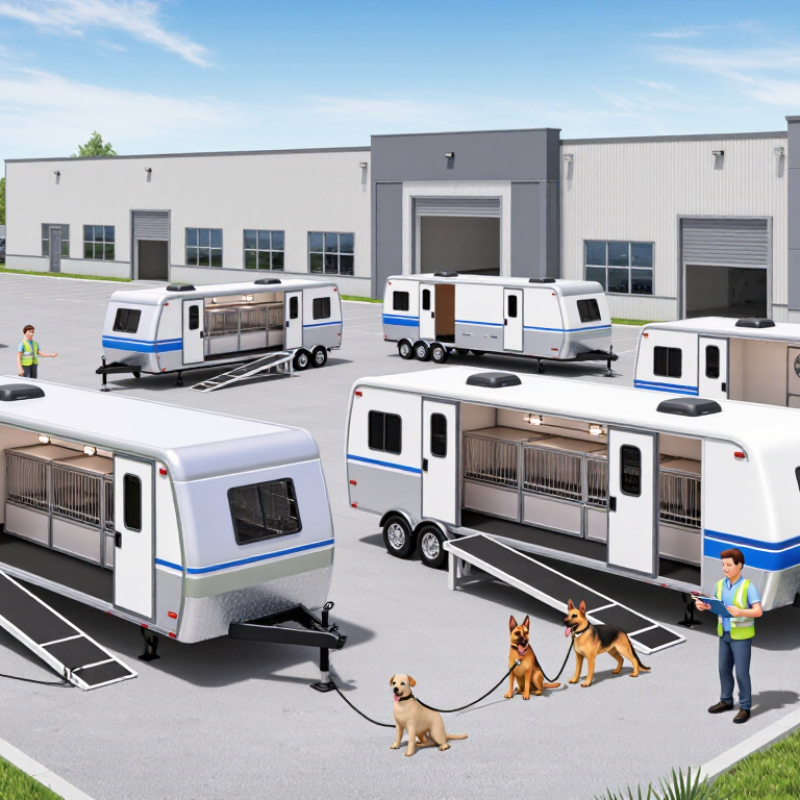
A dog float trailer is a towable, buoyant platform designed to carry a dog on calm water. It usually has a non-slip deck, raised sides, drainage holes, and attachment points. Some models include a small ramp, making entry easier for older or nervous dogs. The term is not perfectly standardized, however. Some sellers describe a floating platform, while others mean a land trailer with flotation support. Buyers should check the actual structure before ordering.
In practical use, handlers move the trailer beside a dock or tow it slowly behind a suitable boat. The dog should wear a properly fitted flotation vest, even when the platform appears stable. A short lead can prevent jumping, but it must not create a strangulation risk. Inspect seams, frame joints, towing lines, and weight limits before every session. Keep the dog away from propellers, sharp edges, and strong currents. Calm water is the sensible starting point.
Watch the dog’s behavior. Panting, shaking, stiff posture, or repeated attempts to leave may signal stress. Training on land can help the animal accept the deck and ramp. Never assume swimming ability equals water confidence. Weather changes quickly, and a quiet surface can become unstable within minutes. My own practical view is simple: these trailers can support recreation and controlled exercise, but they demand active supervision. Convenience should never replace judgment.
A dog float trailer is a towable watercraft designed to transport dogs safely on lakes, rivers, and calm coastal waters. The table below summarizes ten common product configurations and practical specifications used when evaluating dog float trailers.
| No. | Trailer Configuration | Typical Dog Capacity | Common Use | Typical Construction | Buoyancy and Stability Features | Recommended Towing Method | Important Safety Requirements |
|---|---|---|---|---|---|---|---|
| 1 | Single-Dog Compact Float | 1 small or medium dog | Short recreational trips, basic water familiarization, and training sessions | Lightweight aluminum frame with an inflatable or molded float body | Wide base, low center of gravity, and multiple independent air chambers when inflatable | Low-speed towing by a small electric or petrol-powered boat | Use a canine life jacket, secure the tow line to a designated towing point, and keep the dog within the recommended weight limit |
| 2 | Two-Dog Recreational Float | 2 small or medium dogs | Family boating, swimming breaks, and controlled open-water recreation | Welded aluminum or marine-grade polymer deck with flotation tubes | Symmetrical flotation, non-slip flooring, and raised side tubes for improved balance | Boat towing at a controlled, low wake-producing speed | Distribute the dogs evenly, inspect all attachment points, and avoid sudden turns or rapid acceleration |
| 3 | Large-Breed Float Trailer | 1 large dog or 2 medium dogs | Transporting heavier dogs that require additional deck area and load capacity | Reinforced aluminum chassis with high-density polyethylene or coated marine fabric components | Increased beam, reinforced cross-members, and high-volume flotation chambers | Stable motorboat or personal watercraft with an approved towing connection | Confirm total payload, including dogs and equipment; do not exceed the rated capacity or freeboard requirement |
| 4 | Multi-Dog Training Float | 3 to 4 small or medium dogs | Water-retrieval practice, dock-diving preparation, and supervised canine fitness activities | Rigid deck platform with tubular flotation elements and removable partitions | Non-slip deck surface, perimeter grab lines, and balanced flotation on both sides | Slow towing behind a training boat in protected water | Use one handler for supervision, provide separate restraint points when appropriate, and maintain clear access to every dog |
| 5 | Rescue and Recovery Float | 1 dog plus recovery equipment | Assisting with controlled retrieval exercises or transporting equipment during water-rescue training | Heavy-duty aluminum or marine polymer structure with reinforced towing hardware | High freeboard, perimeter grab handles, bright visibility panels, and stable boarding edges | Low-speed towing by a rescue or support boat | Use only in supervised operations; include flotation aids, signaling equipment, and a release system suitable for emergencies |
| 6 | Inflatable PVC Float Trailer | 1 to 3 dogs, depending on tube diameter and deck size | Portable recreation, storage in limited spaces, and occasional seasonal use | Multi-layer PVC or similar coated fabric with an inflatable drop-stitch or slatted deck | Separate air chambers, pressure-relief valves, and wide flotation tubes | Hand-towed or boat-towed at low speed using a reinforced D-ring or tow bridle | Check air pressure, seams, valves, and puncture protection before every use; keep sharp claws away from unprotected fabric |
| 7 | Rigid Platform Float Trailer | 2 to 4 dogs | Frequent use, dockside boarding, and activities requiring a firm standing surface | Marine-grade aluminum, fiberglass, or rotationally molded polyethylene platform | Rigid deck, molded flotation compartments, anti-slip coating, and reinforced perimeter rails | Boat towing through a fixed central bridle or reinforced bow point | Inspect deck fasteners and tow hardware regularly; ensure the platform remains level under the intended load |
| 8 | Foldable Transport Float | 1 to 2 dogs | Travel, camping, storage, and launch sites where compact transport is important | Folding aluminum frame with fabric flotation tubes or detachable pontoons | Locking frame joints, stabilizing side floats, and a low-profile deck | Short-distance hand movement or low-speed towing from a stable boat | Verify that all folding locks are fully engaged and never tow the unit when the frame is partly folded |
| 9 | Canopy-Equipped Float Trailer | 1 to 3 dogs | Longer recreational outings in sunny or lightly rainy conditions | Rigid or inflatable float body with a lightweight fabric canopy and corrosion-resistant fittings | Wide flotation base, shade canopy, non-slip floor, and elevated ventilation openings | Low-speed towing on calm inland waters | Secure the canopy against wind, provide ventilation, prevent overheating, and do not use the canopy as a lifting point |
| 10 | Custom Commercial Float Trailer | Capacity determined by the engineered design | Professional training centers, aquatic therapy programs, rental operations, and organized events | Engineered aluminum, composite, or marine polymer structure with application-specific fittings | Calculated buoyancy, reinforced towing system, drainage, grab rails, and replaceable deck surfaces | Commercial support boat operated by trained personnel | Require documented load ratings, operating procedures, regular inspections, appropriate insurance, and compliance with local waterway regulations |
It is a towable, buoyant platform for carrying a dog on calm water. Most designs have a non-slip deck, raised sides, drainage holes, and attachment points. Some include a small ramp. The name is not standardized. Check the actual structure before buying.
A handler may place it beside a dock or tow it slowly behind a suitable boat. The dog should wear a properly fitted flotation vest. Use a short lead only if it cannot cause strangulation. Keep the platform away from propellers and sharp edges. Slow movement matters.
Inspect seams, frame joints, towing lines, and weight limits before every session. Check flotation chambers and drainage openings for damage or blockage. Confirm that the floor feels firm under pressure. Inspect it yourself. Catalog photos are not proof.
Yes, a properly fitted vest is strongly recommended. A stable-looking platform can still shift, tilt, or become wet. Swimming ability does not guarantee water confidence. The vest should allow comfortable movement without slipping over the dog’s head. Fit matters.
Train the dog on land before using the trailer. Let it investigate the deck, ramp, and side rails slowly. A small ramp can reduce the effort needed for older dogs. Reward calm behavior, then stop before the dog becomes overwhelmed. Do not rush entry.
Panting, shaking, stiff posture, and repeated escape attempts may indicate stress. Move the platform to calmer water and reduce the session length. If the dog remains distressed, return to shore. A quiet surface may change quickly. Trust the warning signs.
Review material data, load-testing records, assembly drawings, and inspection procedures. Examine welds, flotation chambers, towing joints, and spare-part availability. Independent inspection is more reliable than factory videos alone. Ask for sample measurements before ordering large quantities. Appearance can mislead.
Lightweight aluminum frames may simplify towing and handling. Reinforced PVC pontoons and sealed seams can support flotation reliability. Non-slip flooring helps wet paws stay secure. Stainless fittings, adjustable rails, and removable ramps may improve usability. Drainage still deserves attention.
Foldable designs may help owners with limited storage space. Customized platforms can suit clubs, rescue groups, or recreational users. However, added features may complicate repairs and increase weight. Ask about measurements, replacement parts, and real load limits. More features are not always better.
This guide explores what a Dog Float Trailer is and how it supports the safe and efficient transport of dogs during water-based activities, training, rescue preparation, or recreational events. It explains the trailer’s basic structure, towing requirements, flotation features, ventilation, drainage, safety restraints, and ease of loading and unloading. The article also introduces practical criteria for evaluating Chinese manufacturers, including production experience, engineering capability, material quality, testing procedures, quality control, communication, and after-sales support.
A comparison of China’s top 10 Dog Float Trailer manufacturers focuses on product design, durability, corrosion-resistant materials, flotation systems, towing stability, interior comfort, and customization options. Buyers can also learn how to assess trailer capacity, storage layout, color and branding needs, spare-parts availability, certifications, lead times, and export experience. By reviewing samples, factory capabilities, technical documents, and service terms, customers can make a more informed decision and select a reliable supplier that offers consistent quality, transparent pricing, and long-term cooperation.
